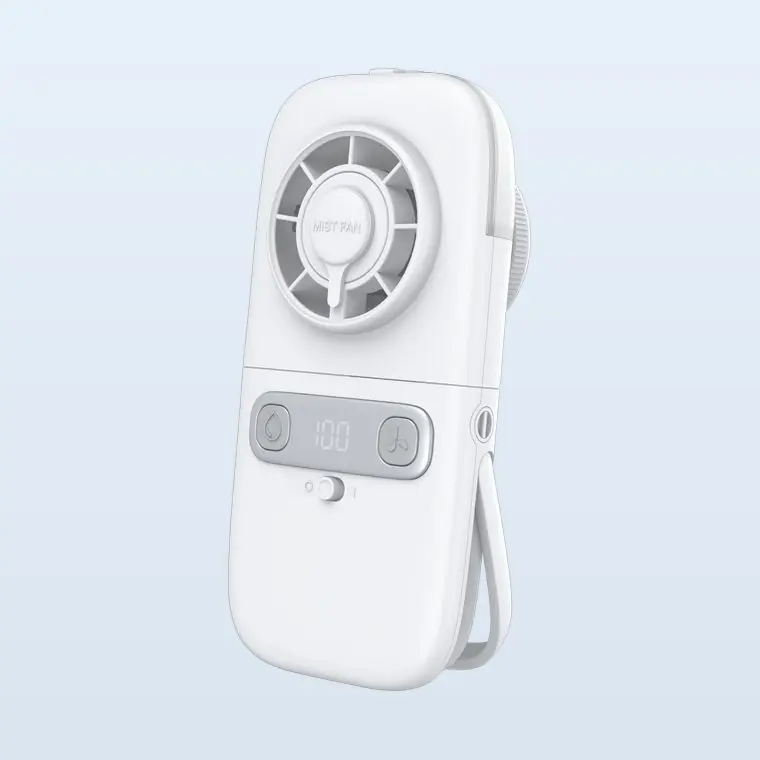
Three ways to hold one fan
The FB26 folds. That one hinge gives you a handheld fan, a desk fan and a neck fan — along with one rule about mist that we learned by getting it wrong.
Most small fans spend their whole life in one position. They are designed for a hand, or a desk, or a neck, and the other two possibilities are never considered. The FB26 started as a handheld fan and became three fans when somebody folded the stand out, put it on a table, and then hooked it over a collar. The hinge was ours; the other two uses were found by accident. This is the story of what had to change to make all three real.
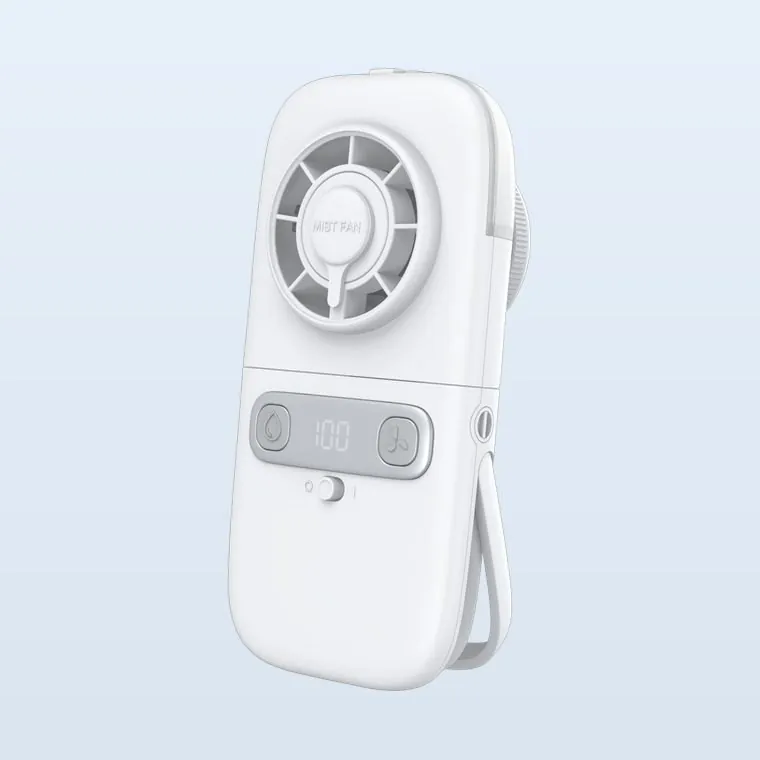
01 — Three positions, one object
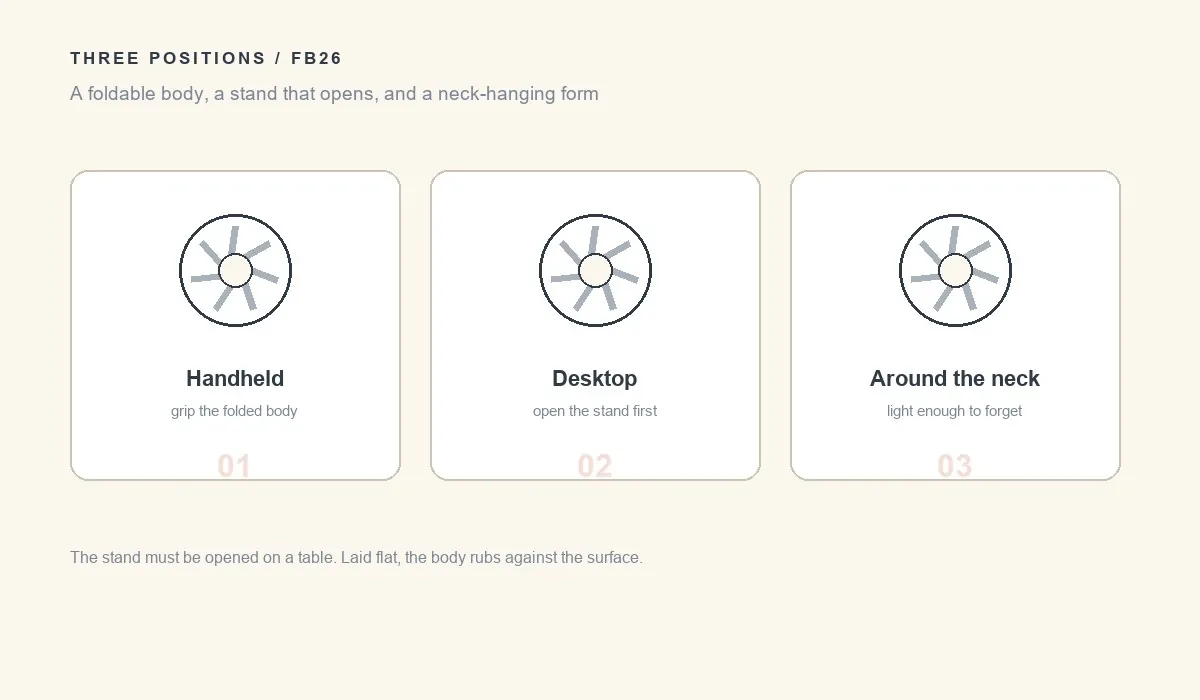
Folded, the FB26 is a handheld fan. Open the stand and it stands on a table. There is also a way to hang it at the neck, which turns both hands free. Three uses sound like three sets of engineering, but they all come back to the same small set of parts: a body, a hinge and a stand that doubles as a rest. When we tried to design the three modes separately we got three joints and a fan that felt like a kit. Combining them was less elegant on paper and much better in the hand.
The body measures 78 × 47.6 × 160 mm, which is compact enough to carry and long enough to sit steadily when opened. The mist tank holds 50 ml and there is a 30 ml filling bottle in the box. Speed and cooling each get a hundred levels, so the fan can be quiet on a desk and forceful in a hand. The modes are meant to feel like one product changing posture, not three products taking turns.
02 — The stand is not decoration
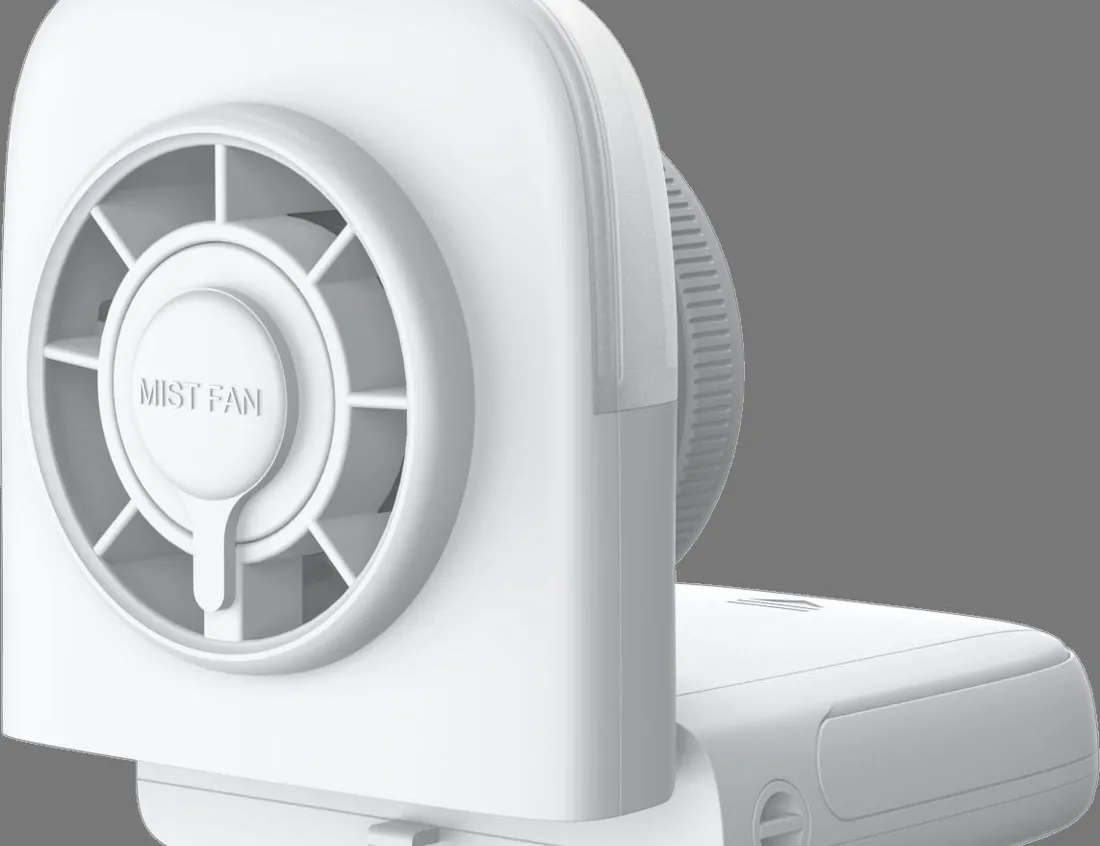
There is a detail in the desk mode that nobody notices until they ignore it. The stand has to be open. You cannot simply lay the folded fan flat on a table and expect it to work as a desk fan, because in that position the stand rubs against the body. We tried it — more than once, because it seems like the obvious thing to do — and came away with scuffed corners and a fan that sat at a useless angle.
So the opened stand is the desk mode, and that is stated plainly rather than buried. This is the kind of constraint a designer learns to respect instead of argue with. The hinge is stiff enough to hold the chosen angle and still folds with a thumb. It is not the most glamorous part of the FB26, but it is the part that decides whether the fan stays where you put it or slowly slides down a table while you are working.
03 — A cell the user can change
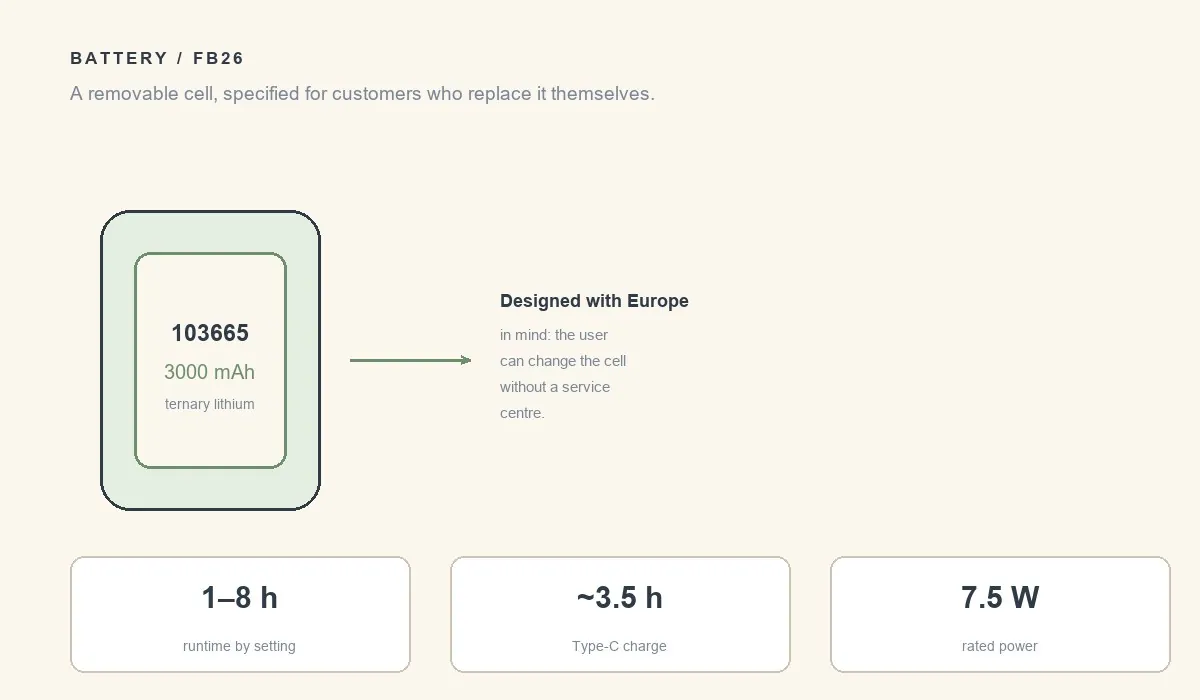
The battery in the FB26 is a 103665 ternary lithium cell, 3.7 V and 3000 mAh, and it is removable. That combination was driven by the European market, where a customer expects to be able to replace a worn cell without sending the whole product back or hunting for a service centre. We designed for that expectation from the first drawing rather than adding an access hatch later.
Charging is Type-C at 5 V/2 A and takes about 3.5 hours. The fan draws 7.5 W, and runtime ranges from 1 to 8 hours depending on what you ask of it — the top of that range belongs to gentle use with the mist off, not to the fan running flat out. I would rather describe the range honestly than quote the optimistic end and let the battery explain the rest. A removable cell only helps if you can buy a spare, and this one is a standard part.
04 — The rule about mist
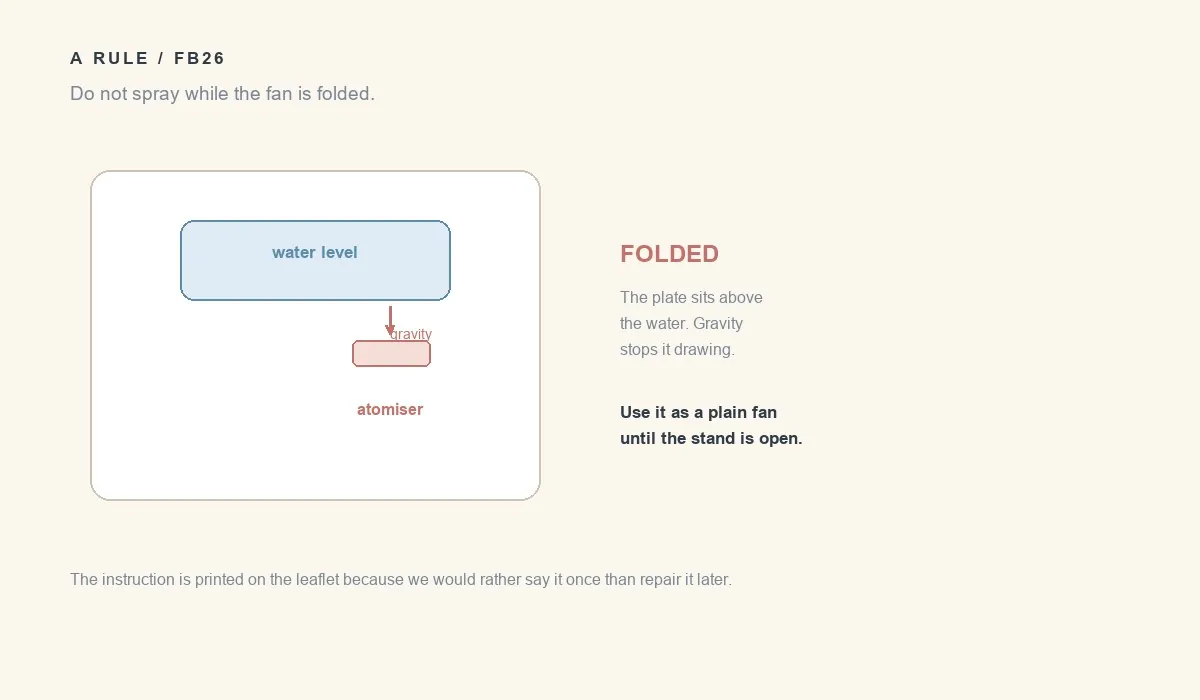
Here is the mistake I mentioned at the top. The mist plate sits above the water line. When the fan is upright, gravity and the wick feed it; when the fan is folded, the plate ends up above a surface the water can no longer reach reliably. In that position the mist function does not work, and we should have said so on the first prototype rather than after a handful of confused emails.
So the rule is simple: do not run the mist while the FB26 is folded. A folded FB26 is a perfectly good ordinary fan, and there is nothing wrong with using it that way. The 50 ml tank and the hundred-step mist control are still there for when you open it up. We kept the mist function because it is worth having in the upright modes, even at the cost of one clear restriction. Pretending the restriction did not exist would have been worse.
A product with three jobs lives or dies by the one rule you forget to print on the box.
05 — Hanging, and where the weight sits
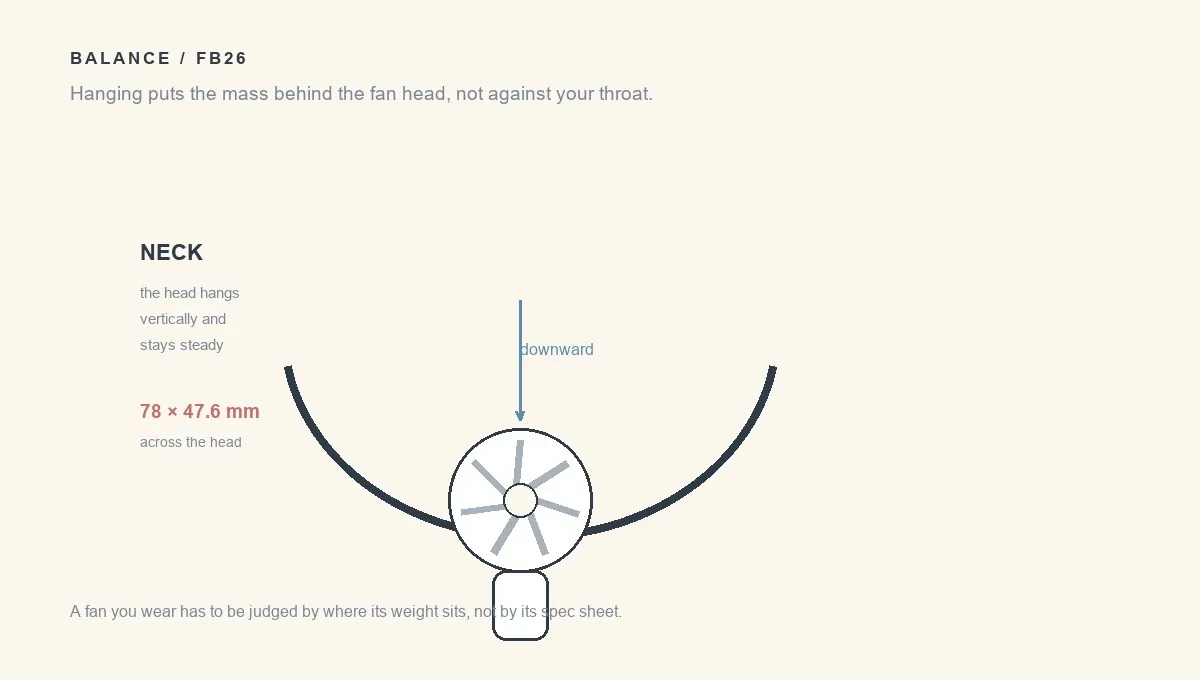
In neck mode the FB26 hangs in front of you while the stand folds away. This is the mode that asked the most of the shape. A fan at the neck has to sit close without pressing, and its weight has to be centred or it swings when you turn your head. At 160 mm tall and with the cell near the middle of the body, it stays close enough that you forget it is there.
We tested long walks, not just still poses, because a neck fan that is comfortable for thirty seconds and unbearable for ten minutes is a failed neck fan. The same seven-and-a-half watt motor that moves air in the hand has to do it while the fan is swinging slightly with your step. That is the price of making one fan do three jobs: each mode has to be good enough on its own, and none of them gets to be an afterthought.