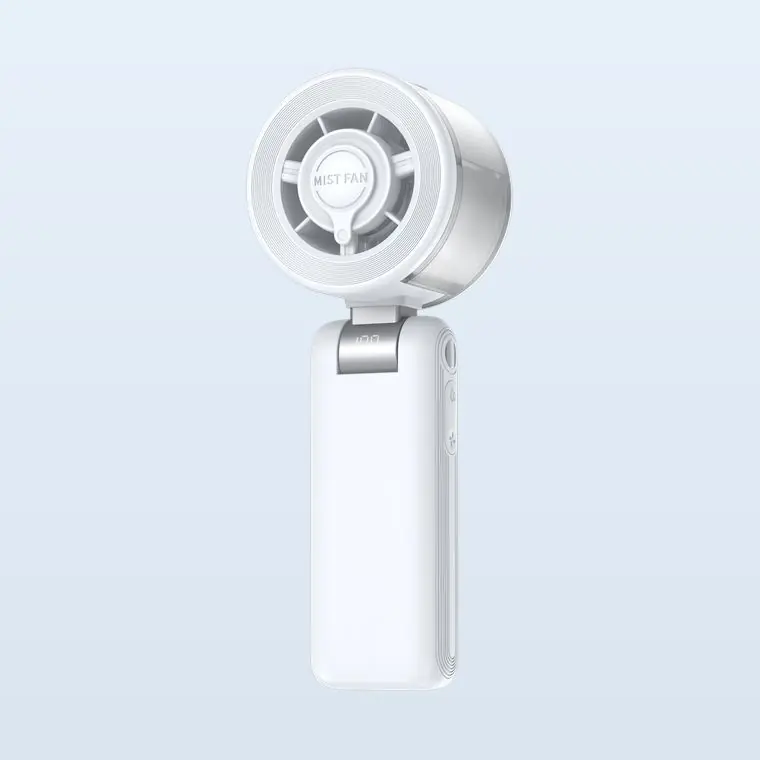
Built for the bag
The FB27 shares the FB26's three positions, but it was drawn for a life in a backpack. The carabiner, the seal and the display all answer one question: what survives being thrown in a bag?

The FB26 and the FB27 are built on the same idea and look like cousins. Both fold, both work in the hand, on a desk and at the neck, and both carry a 50 ml tank. The difference is where each one expects to spend its life. The FB26 is a fan you pick up. The FB27 is a fan you put in a bag and forget until you need it. That shift in emphasis changed three parts in ways that are easy to miss in a photograph.
01 — Where it actually lives
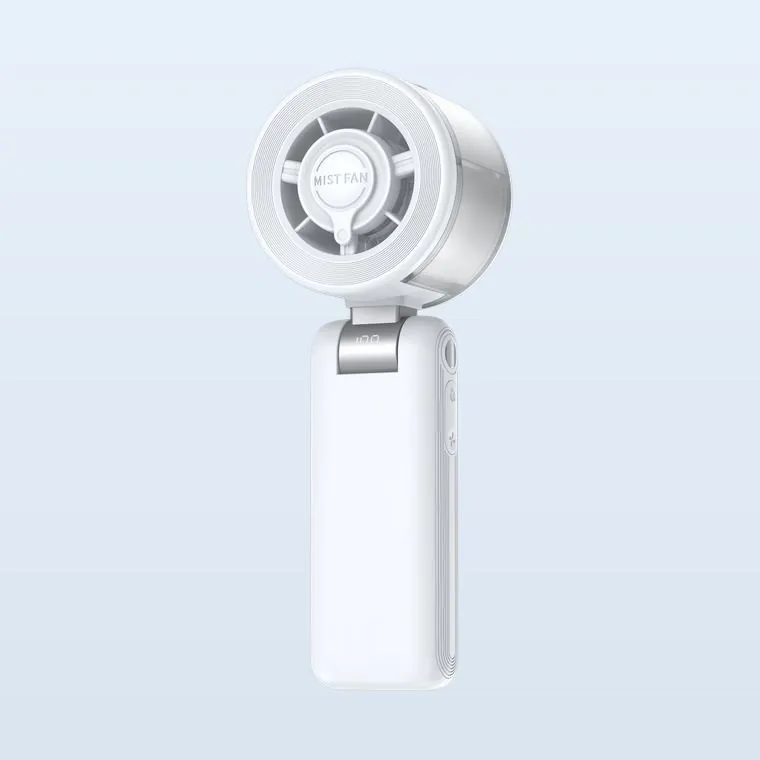
When we watched how people carried the earlier fan, the telling moment was not use but storage. It went into a bag, often still folded, often next to a water bottle or a set of keys. The FB27 starts from that moment. Its three positions are the same three as the FB26 — hand, desk, neck — but the design weight sits with the neck and the bag, because that is where the fan spends most of a day.
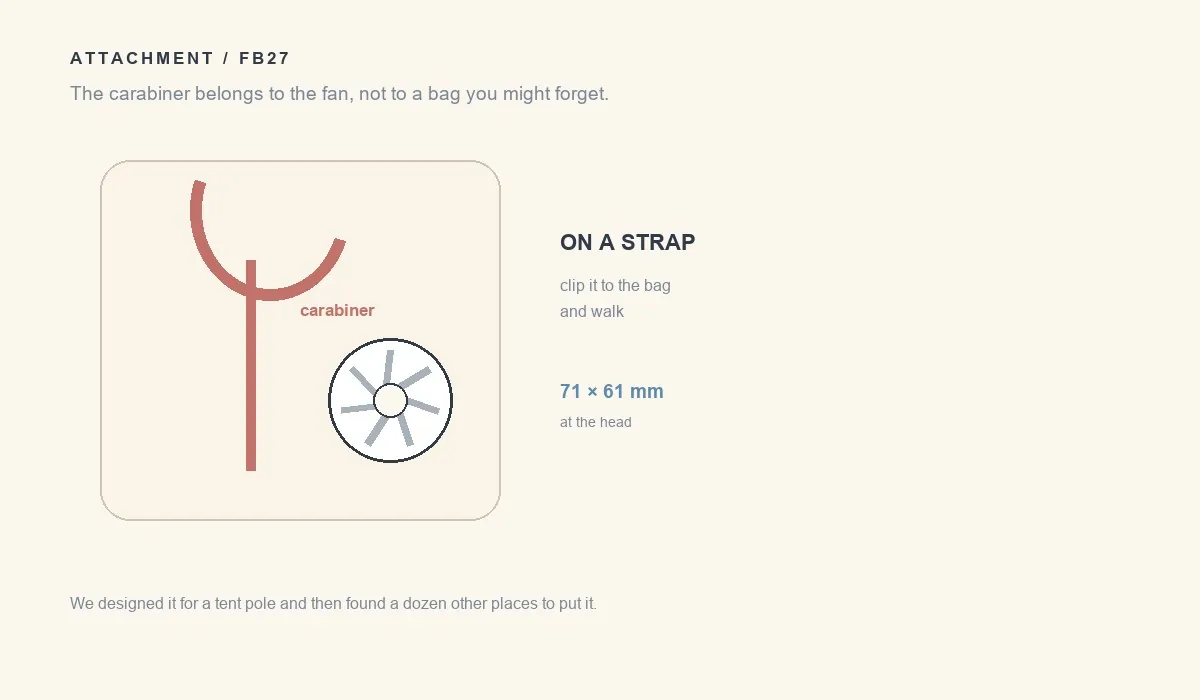
That decision shows up in the outline. The FB27 is 71 × 61 × 160 mm, a little wider where the carabiner and the cell sit and a little shallower than its cousin. Nothing about it is dramatic. It is simply arranged so that the parts you grip, clip and read are on the side you can reach when the fan is already hanging from a strap. A fan designed for a bag has to be legible while it is still in the bag's company.
02 — The carabiner is the point
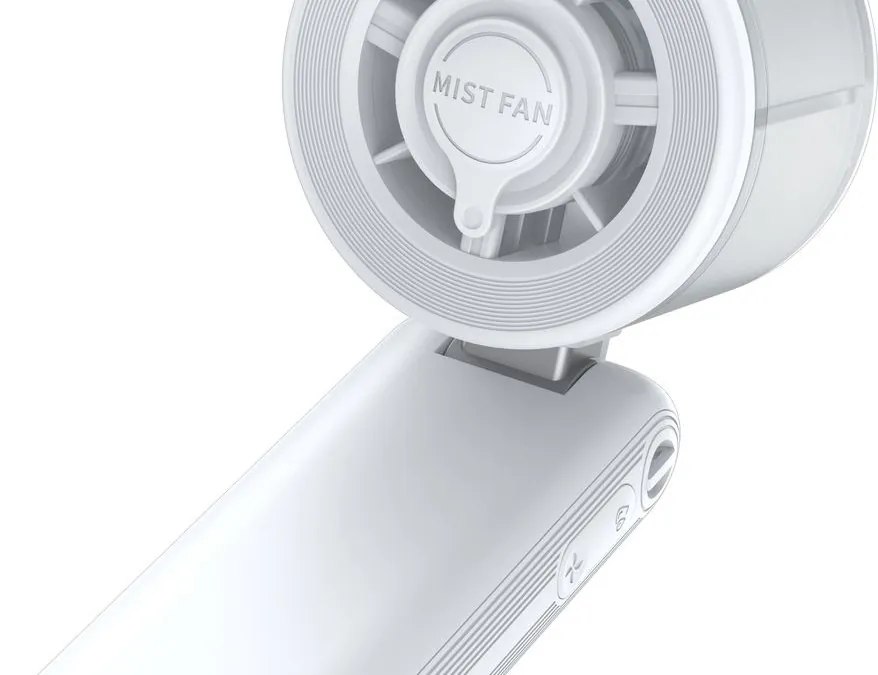
The FB27 has a carabiner, and it is not a decorative loop. It clips to a backpack strap in one motion, which is the difference between a fan you carry in your hand and a fan that carries itself. On a walk, a strap-mounted fan sits at chest height, where the moving air actually goes past your face. Held in the hand, it has to compete with whatever else you are holding.
We considered a soft strap first, because it is lighter and kinder to a bag. The problem is that a soft strap needs two hands to attach and tends to twist. A carabiner can be clipped with one thumb while the other hand is doing something else, and it holds a fixed orientation. It makes a small clicking sound that some people will like and others will not. We chose it for the one-handed clip, which matters more on a moving day than the sound does.
03 — A filling port that closes
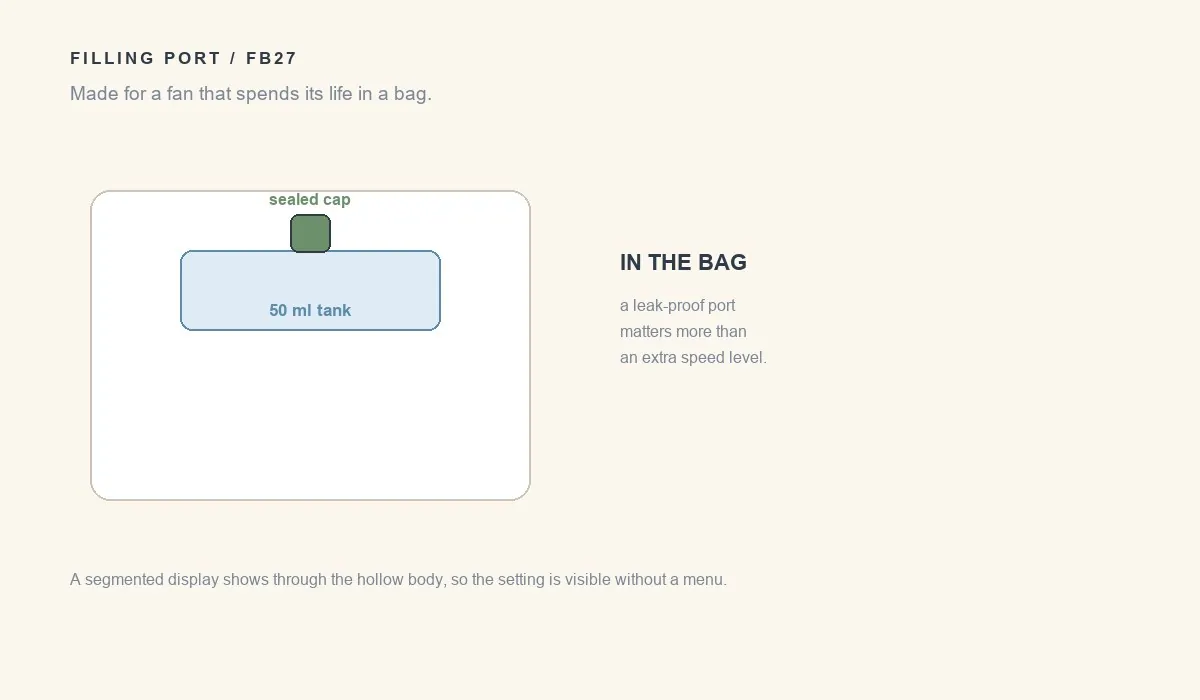
The tank holds 50 ml and the box includes a 30 ml filling bottle, just as on the FB26. What is different is the filling port. The FB27's port seals, because a neck fan that has been dropped into a bag spends time sideways, upside down and under pressure from whatever else is in there. A fan that leaks on a desk is an inconvenience. A fan that leaks in a bag ruins the thing beside it.
The seal is the part of this design I am most glad we insisted on. It is easy to leave a specification like that until late in a project, especially when the early samples look fine on a bench. They do look fine on a bench; benches are upright. We tested filled units in bags, and that was the end of the argument. A sealed port costs a little more and makes the filling gesture slightly slower. Both are worth it compared with finding a wet patch in a backpack.
04 — A screen you can catch in passing
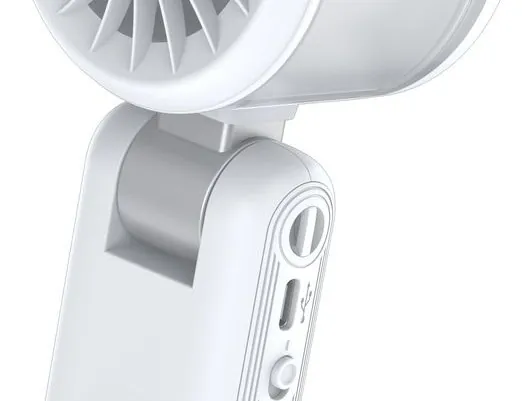
The FB27 has a segmented digital display that shows through the hollow part of the body. It reports speed and cooling, each of which has a hundred levels. A full colour screen would have been easier to read in theory, but it would have filled the hollow space that makes the fan light and it would have needed a menu to be useful. Segmented digits do one job: they tell you the number at a glance.
The hollow body is doing double duty here. It saves material where material is not needed, and it gives the display somewhere to live without adding a raised panel that would catch on a bag strap. When the fan is clipped to a backpack, most of the time you do not look at it at all. When you do, you want to read the setting in half a second and go back to what you were doing. That is a narrower goal than a smart screen, and a much easier one to meet.
05 — Two cells, one switch
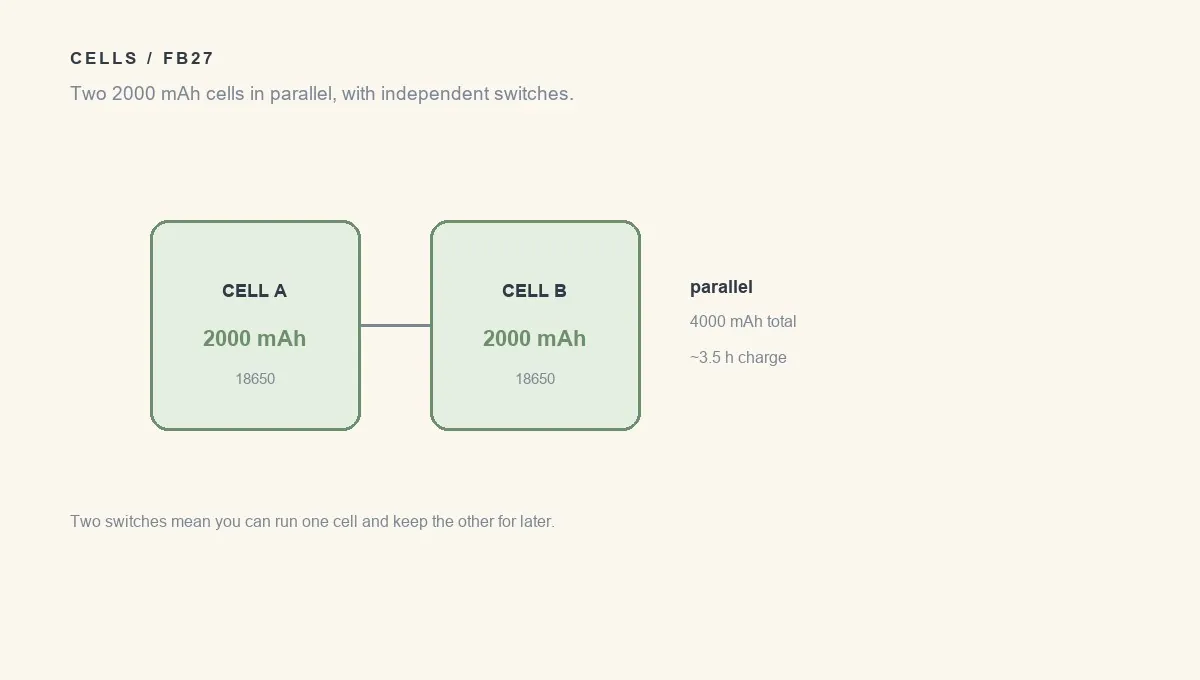
Inside are two 2000 mAh 18650 cells wired in parallel, giving 4000 mAh in total. Each cell has its own switch, so they can be isolated independently. Parallel cells are not a way of doubling voltage here; they are a way of using a common, well-understood cell size while keeping the pack shape suited to a narrow body. It also means a replacement is easy to source.
Charging is Type-C at 5 V/2 A and takes about 3.5 hours. The motor draws 7.5 W, with runtime from 1 to 8 hours depending on speed and whether the mist is running. Those are the same figures as the FB26, which is what sharing a platform buys you. What the FB27 adds is not a bigger number but a set of decisions about where the fan goes: a clip that attaches with one hand, a port that stays shut, and a display that can be read while you are already walking away.
A bag does not care how good your fan looks. It only tests whether the lid stays shut and the clip stays clipped.