The tank comes off
We spent more time arguing about how to put water into the FS52 than about how it sprays it. The mist was the easy part. The hard part was the moment before the mist — a tap, a small opening, and a fan that kept getting wet.

I used to think the hardest part of a mist fan was the mist. After living with the FS52 for a few weeks I changed my mind. The hardest part was the water. Not the spray pattern, not the pump, not the noise — the plain act of getting water into a small fan without getting the rest of the fan wet. It sounds like a trivial complaint until you watch someone try to do it on a train, or at a desk with a laptop underneath.

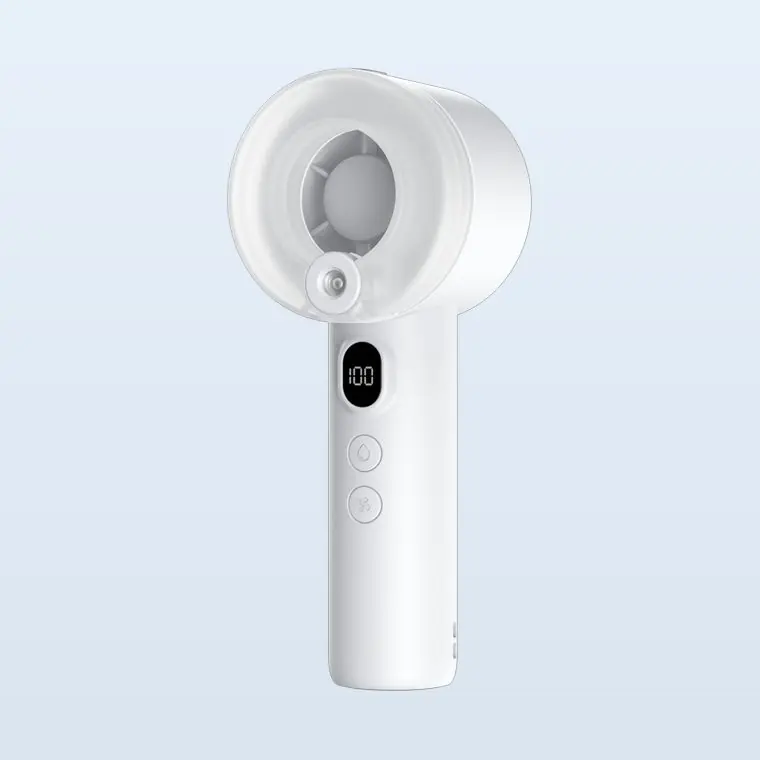
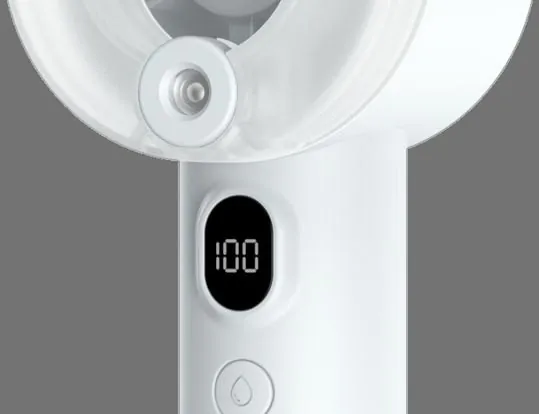
The FS52 looks like a handheld fan should. It is white, it is slim, and it is compact enough to disappear into a bag. There is no attempt to look technical, and no mechanism on display for its own sake. We drew it that way on purpose: a product that gets used in public should not need explaining to the people around you.
This piece is about one decision — making the tank come off — and the chain of small consequences that followed from it. It is not a story about a breakthrough. It is a story about a nuisance we finally took seriously enough to design around.
01 — The fill is the problem
Most mist fans ask you to pour water into a small opening up near the head. That opening is never quite where your hand naturally is, so you tilt the fan to reach it. When you tilt it, the water goes somewhere else. On earlier products like this one, somewhere else was the seam between the head and the handle, or the area around the controls. You could dry it afterwards. You just could not pretend it had not happened.
We watched people refill these things, and the same short sequence kept appearing: tilt, miss, wipe, then check that the buttons still worked. Nobody wrote in to complain about it. They simply stopped using the mist function after a day or two, which is a worse signal than a complaint. A feature people quietly abandon is a feature you paid for and they did not want.
There is a defensive argument that says water near electronics is fine because the housing is sealed. That may be true, but it misses the point. The customer is not thinking about ingress protection. They are thinking about the damp patch on their desk, and about whether this object is going to behave itself in their bag.
02 — Take the tank off
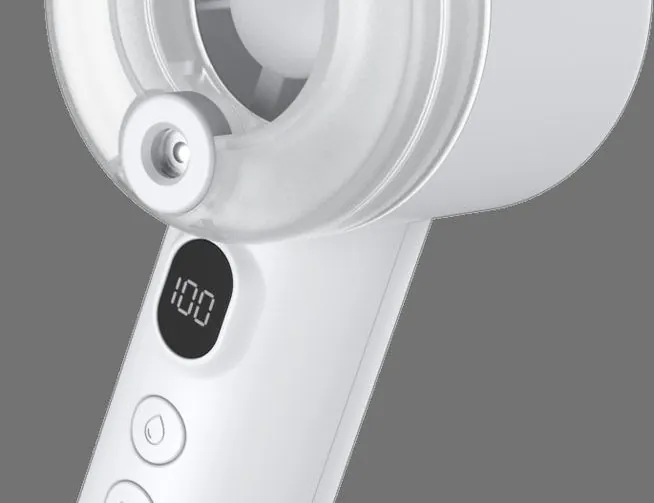
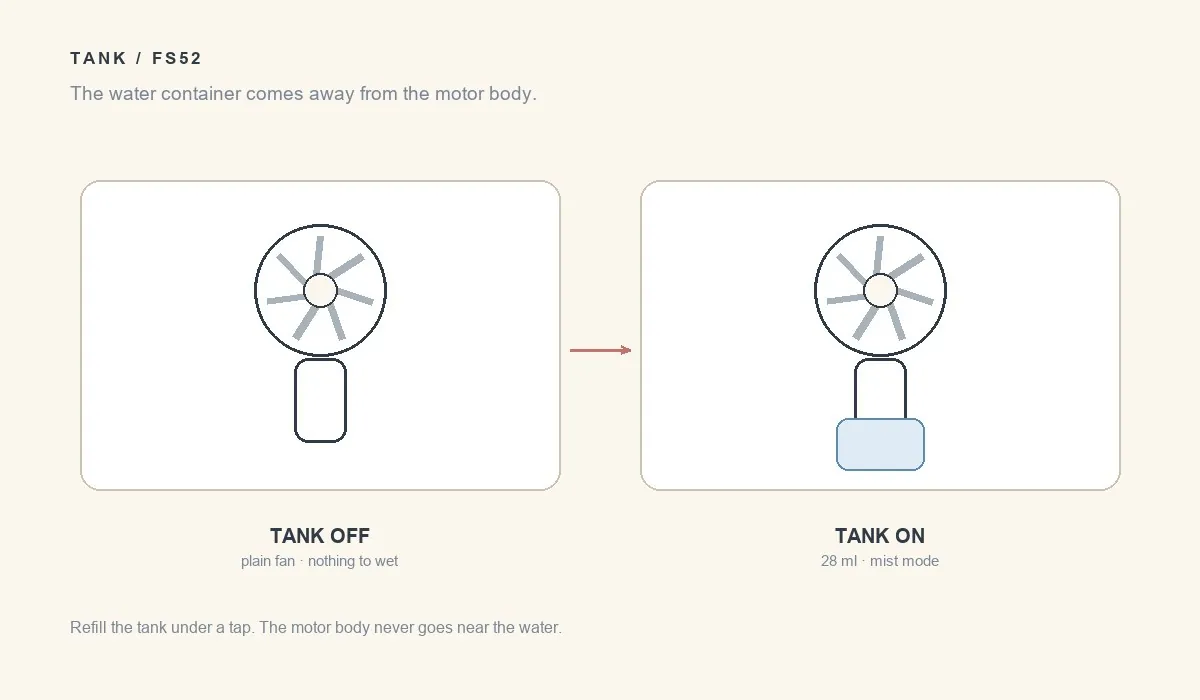
So we separated the water from the machine. The FS52 has a 28 ml tank that lifts away from the body. You fill it at a tap, well away from the motor and the controls, and click it back when you are ready. The fan never has to be tilted, and the body never has to be wiped. The annoying part of the routine simply disappears.
There is a 30 ml filling bottle in the box, because a 28 ml tank is awkward to aim under most taps. The bottle is not a luxury accessory; it is the part that makes the tank practical. We argued about including it — it adds a component, a cost line, and one more thing to lose — and we lost that argument, which was the right outcome.
A removable tank is not free. It adds a joint that can leak and a small part that can be left on a table. We accepted both. The alternative was a fan that quietly loses its mist function by the second afternoon, and that is a far more expensive failure to carry into a market.
03 — Two fans in one
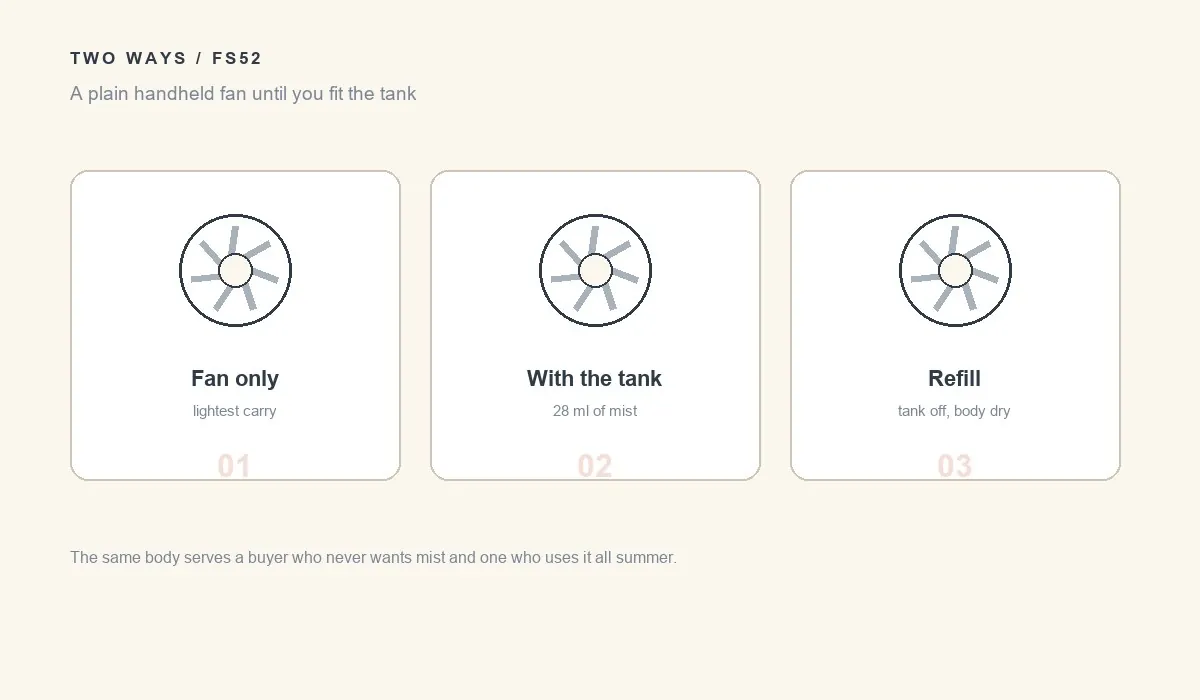
Once the tank comes off, the FS52 becomes an ordinary fan. No water, no mist, no pump running. With the tank on, it mists. That sounds obvious written down, but it changed how we described the product internally: we stopped talking about a mist fan and started talking about a fan with an option.
The 100 speed levels matter here. At the low end the FS52 is quiet enough to keep beside you while you work. At the high end it moves more air than its size suggests. Mist or no mist, the fan part had to stand on its own — otherwise the removable tank would be no more than a way of removing the only reason to buy the fan.
I was uneasy about this at first. A product with two modes can feel like two weak products sharing one housing, and I have seen that happen. But the mode people use most, in our experience, is the plain one. That is an argument for the tank, not against it.
The best thing about a removable tank is that you can choose not to use it.
04 — What you are actually holding
The FS52 measures 68 × 60.5 × 168.6 mm. In the hand it reads as a classic handheld fan: slim, white, and with nothing sticking out that will catch on a bag lining. The tank sits inside the body rather than on the outside of it, so the silhouette does not change when you add water.
That was a deliberate choice. A mist fan with an external bottle strapped to it looks like a science project, and a science project is not what you want to pull out at a bus stop in July. We kept the familiar shape even though hiding the tank cost us tooling time and made the seal harder to get right.
The controls are simple because the context is not. You are holding this with one hand, probably walking, probably in a hurry. There is no menu to step through and no display to squint at in sunlight. Every decision here was in service of keeping the fan from asking for your attention.
05 — The numbers we will admit to
The FS52 draws 5 W and runs on a 2000 mAh cell. It charges over Type-C at 5 V / 2 A and takes about three hours. At speed 100 with the mist running, expect around 1.5 hours of use. Those are the numbers from the specification sheet, and they are the ones I am willing to stand behind.
That last figure is the one I want to be honest about. It is not an all-day figure. It is enough for a commute and an evening, and at lower speeds with the mist off it stretches a long way. We could have printed a gentler number by testing at a quiet setting, but then the number would not describe the mode people actually buy the fan for.
I still go back and forth on whether the tank was the right call. Then I fill one at a desk without spilling a drop, and I stop going back and forth. The FS52 is not a clever fan. It is an ordinary fan that has stopped making a small, persistent mess.