Why a small fan needs a motor
The FS38 is our volume model, so every component has to justify itself in the first ten seconds of use. The oscillation motor was the hardest to defend and, in the end, the one we were most sure about.

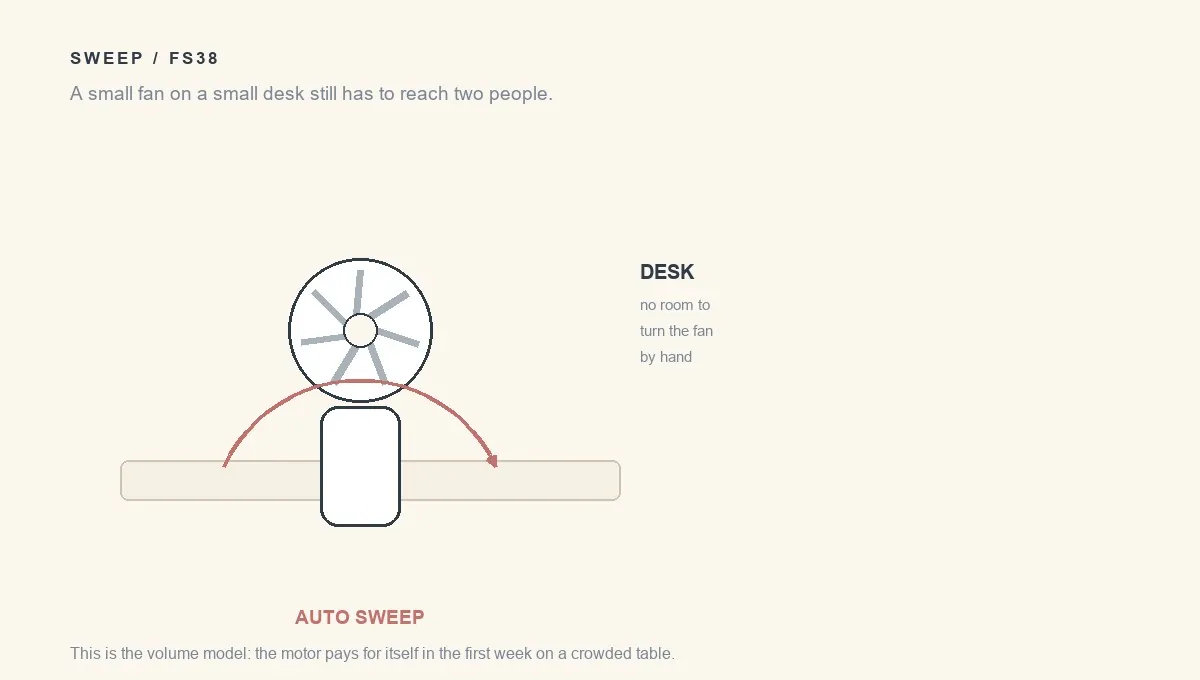
A small fan on a desk has a problem a big fan never has to think about: there is not much room around it. You cannot place it across the room and let it work on the whole space. It sits within arm's reach, pointing at one spot, and everything else stays stuffy. The FS38 is our answer to that, and this is the reasoning behind the choices we made.
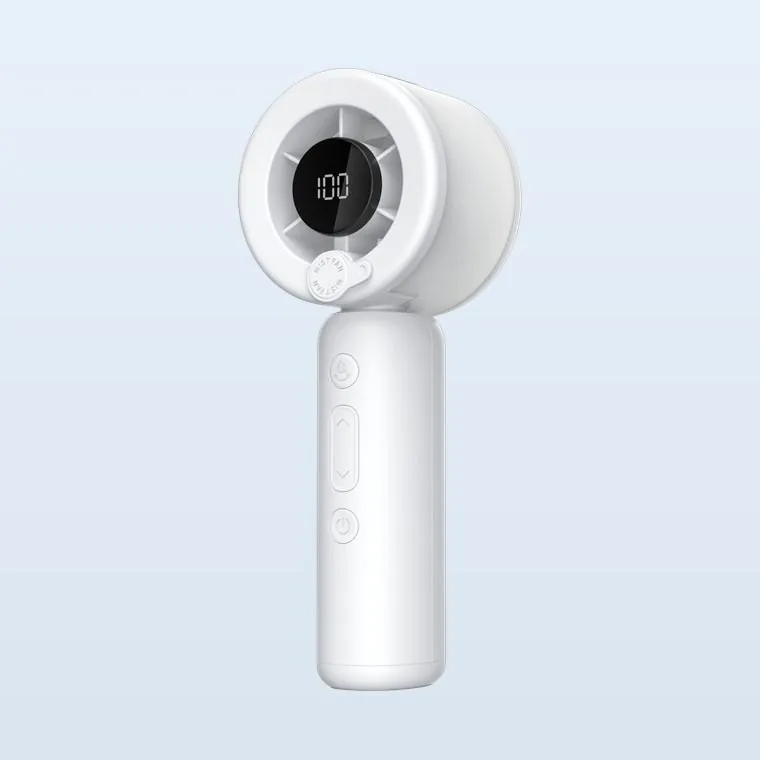
Out of the box the FS38 reads as a summer object. It is white, it is round at the edges, and it does not take itself too seriously. It is meant to be grabbed on the way out and used outside, not kept on a shelf and admired.
Because this is the model we expect to sell in the largest numbers, the decisions here are more constrained than on a showcase product. A clever feature that adds cost to every single unit is a very different proposition when the unit count is high. That tension runs through everything below.
01 — A small desk is a small room
We added automatic oscillation to the FS38 for a reason that has nothing to do with features lists. On a desk, the fan is close to you and the useful area is small. A fixed stream of air is comfortable for about one person in one position. Start to sweep, and the same fan covers the space that a person actually occupies, or two people sitting side by side.
This was argued about at some length. A motor, a gear train and the control logic are not free, and on a volume model they are scrutinised more carefully than on any other product. There was a real case for a cheaper, fixed-head version. I understood that case, and I still think it was reasonable.
What changed my mind was watching the fan used. People rarely sit still in front of a small fan. They lean, they turn, they get up. A fan that follows them around a desk feels like it is doing something; a fan that ignores them feels broken. The motor earns its place through that impression, not through a number on a box.
02 — The mist has to be fine
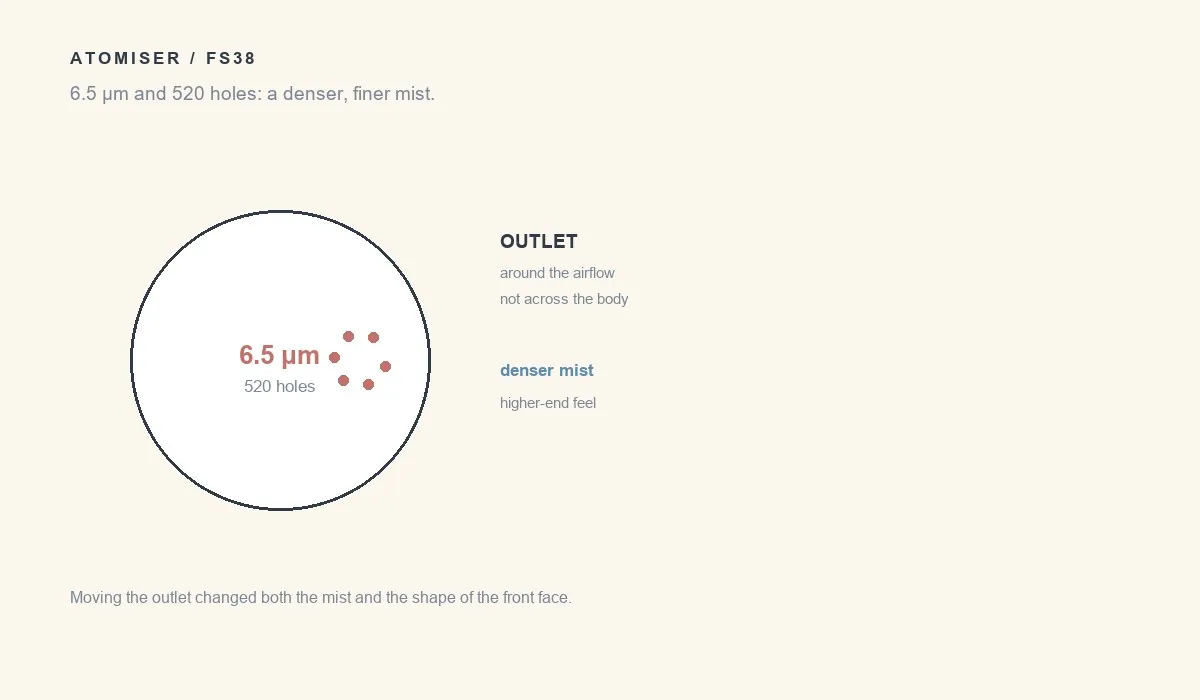
The atomising plate on the FS38 is fixed at 6.5 μm with 520 holes. We did not treat that as a spec to be tuned per customer. A finer, denser mist changes the character of the product: it feels closer to something expensive and less like a water spritz. That is a judgement about how the fan is perceived, and we made it once rather than leaving it as an option.
The mist outlets are placed around the airflow path, not in the middle of the body. This was the more difficult decision. Putting the outlets on the face of the fan would have been simpler to tool and easier to explain, but it would have interrupted the look of the product and fought with the air coming out.
Around the airflow, the mist gets carried where the air is already going, and the front of the fan stays clean. It costs us a more complicated housing and a joint that has to be sealed in several places. On a volume model that is a real penalty, and I would not have accepted it if the mist had been merely adequate.
03 — The bottle comes off too
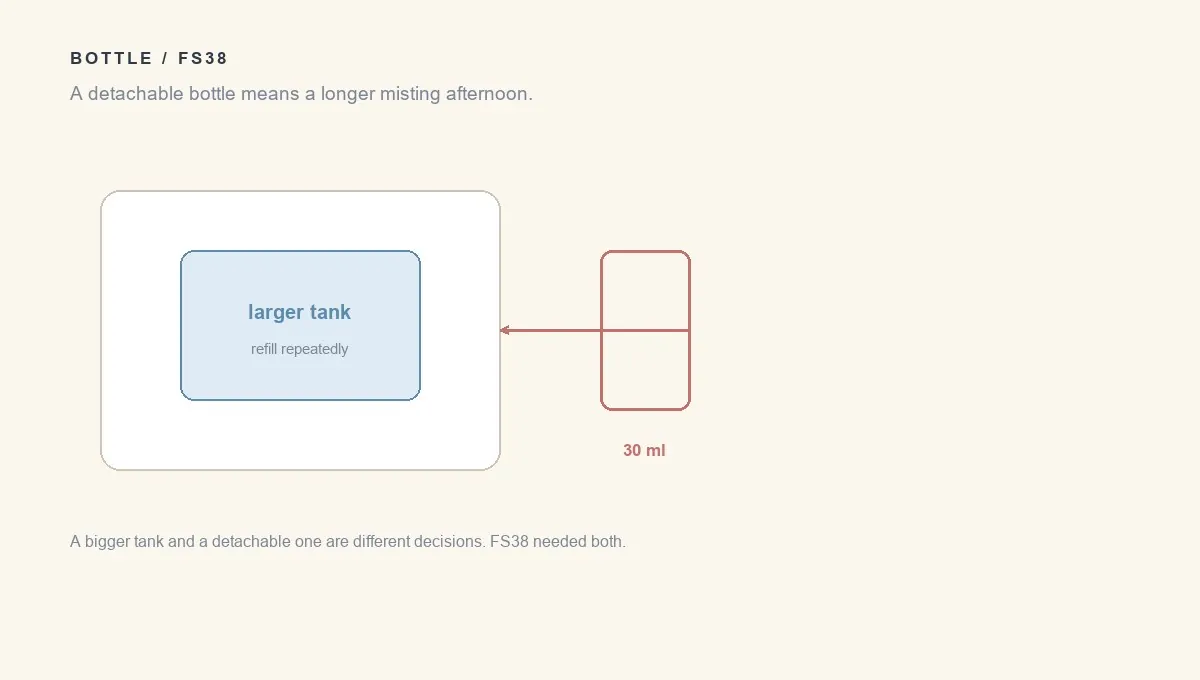
Like the FS52, the FS38 has a detachable water tank. You take the bottle away from the fan, fill it, and put it back. The body stays dry and the controls stay clean. It is a small thing to describe, but it is the difference between using the mist every day and using it twice and forgetting.
The tank on the FS38 is deliberately larger than on the smaller model. A bigger tank means a longer misting session before you have to think about refilling again. There is also a 30 ml filling bottle in the box for the moments when a tap is awkward to reach.
Nothing here is free. A larger tank adds weight to something designed to be held, and a bottle that comes off can be left behind. I worried about both. In practice the extra weight is not noticeable in the hand, and the cost of a lost bottle is far smaller than the cost of a mist function nobody uses.
04 — What it costs to run
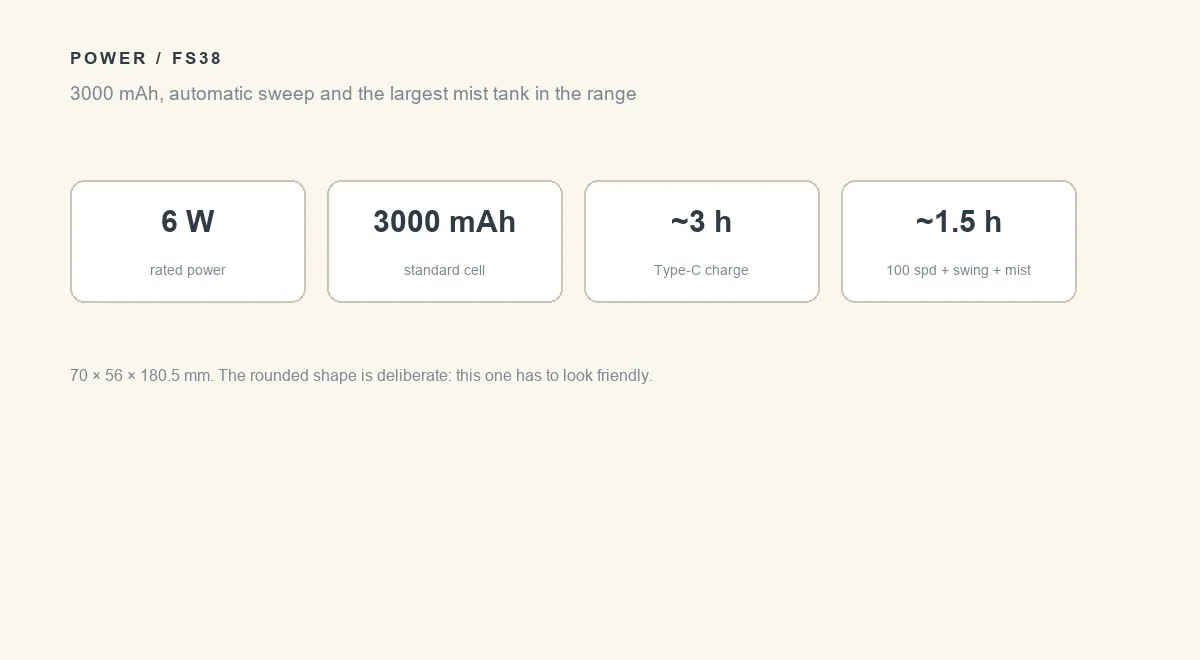
The FS38 uses a 3000 mAh cell and draws 6 W. It has 100 speed levels, charges over Type-C at 5 V / 2 A in about three hours, and runs for roughly 1.5 hours at speed 100 with oscillation and mist both on. Those are the figures we publish, and they are measured in the mode that shows the product at its busiest.
That 1.5 hours is intentionally the demanding case. Switch off the swing, lower the speed, and the fan lasts much longer. I would rather state the harder number and have the customer pleasantly surprised than quote the easiest setting and have them disappointed on the first hot afternoon.
For a volume model, honesty about runtime is also a commercial decision. A customer who feels misled does not buy the next one, and a product like this lives or dies on repeat and word of mouth. The short number is the one worth printing.
05 — Held, or set down
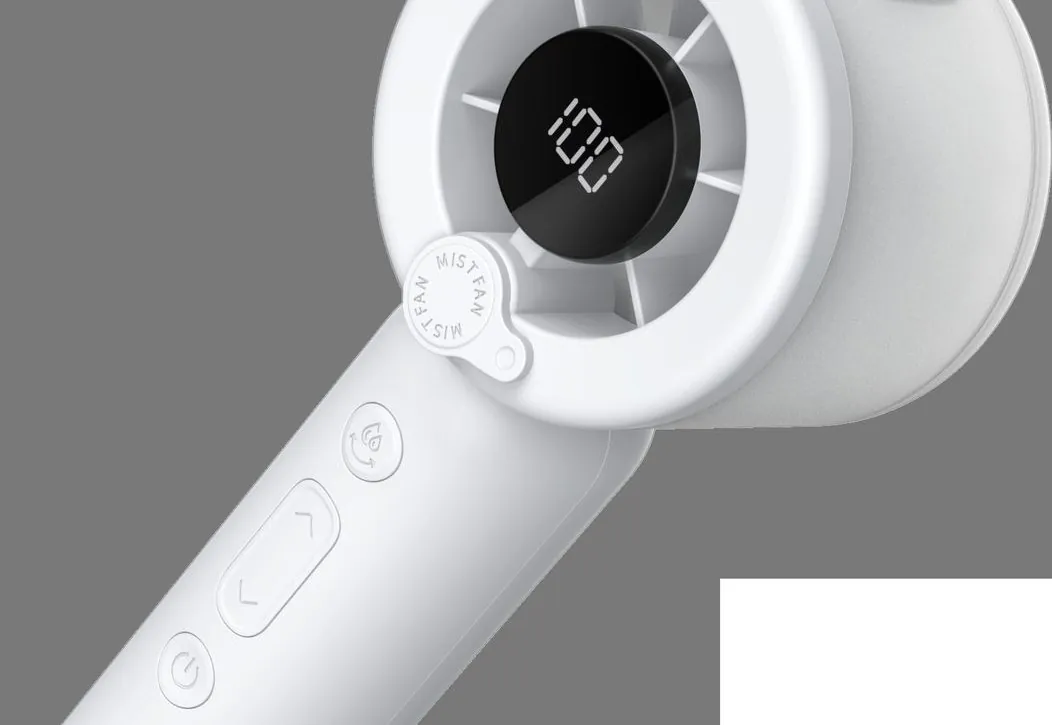
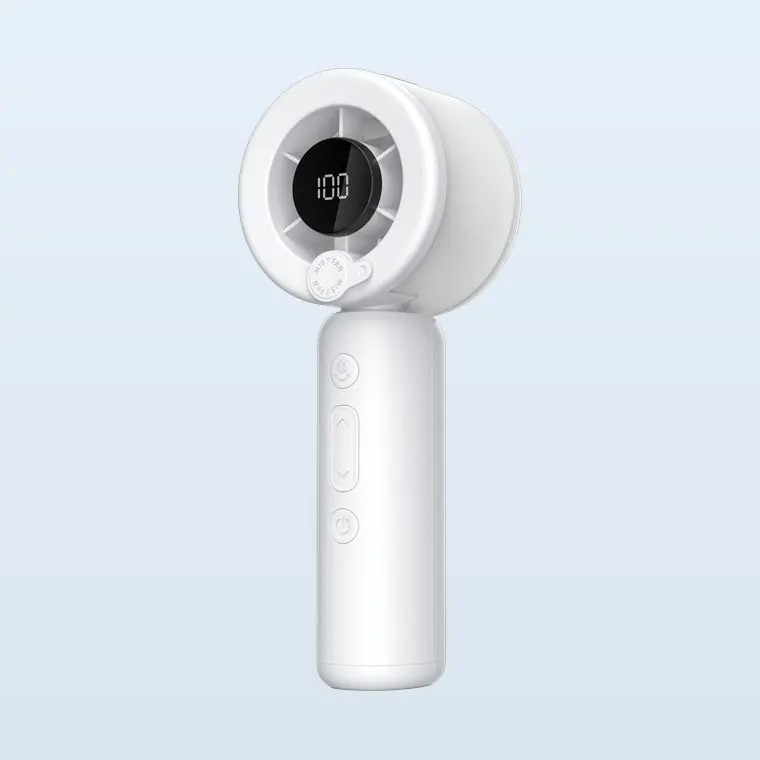
The FS38 measures 70 × 56 × 180.5 mm. It works as a handheld fan and it stands on a desk, and we did not want either role to feel like a compromise. The rounded shape is part of that: it sits comfortably in a hand and it looks harmless next to a keyboard.
The body is white and uncomplicated because the fan is meant to be used outside in summer, where it will get handled, dropped into bags and left in the sun. A finish that needs careful treatment would be the wrong finish for this product.
I still think about the cheaper version without the motor sometimes. It would sell, and it would sell for less. But it would not be the fan I would hand to a friend on a hot day, and that is the test I keep coming back to on this model.
On a volume model, a feature earns its place by being obvious in the first ten seconds, not by being clever on a specification sheet.