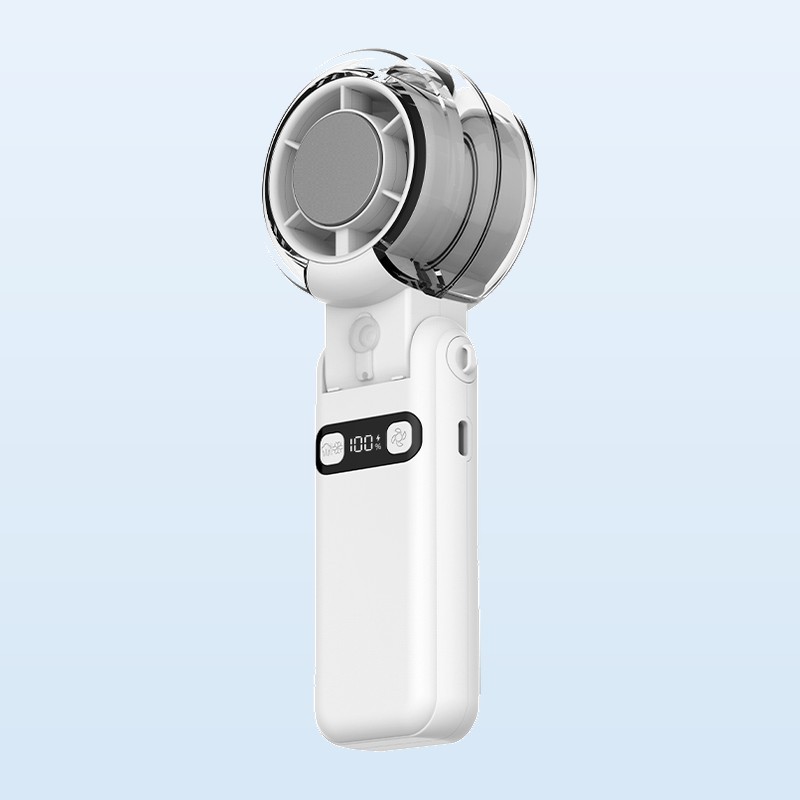
Three kinds of cold in one hand
A fan, a mist nozzle and a cooling plate, all inside 265 grams. The hinge is the part nobody asks about — and the part we rebuilt four times.

Most handheld fans solve exactly one problem: moving air. That works right up until the air itself is 36 °C, at which point you are being fanned with a hairdryer. So with FB23 we stopped thinking of it as a fan and started thinking of it as a very small cooling system with three stages — plate, airflow, mist — and then spent most of the project arguing about where the hinge should go.
01 — The hinge came first
Folding heads are usually an afterthought: a plastic knuckle at the bottom, tight enough to hold, loose enough not to crack. Ours went through four versions before it stopped irritating us. The first one drooped under the weight of the head as soon as you tilted past 45°. The second locked into three positions, which sounds clever until you are at a desk at two in the morning and the angle you actually want sits between two of them.
What we shipped is a continuous friction hinge across the full 120°, stainless pin, nylon collar, no detents. It stays where you leave it. The clicky version felt more expensive in the hand and was worse to live with — a small lesson we keep re-learning.
The hinge also decided the internal layout. The cell moved below it, into the handle. From that point on the head was only a motor, a blade set and a nozzle, which is why it can be tilted with one finger while the rest of the device stays put in your hand.

Three things happen at once when you hold it: air comes out of the front, mist comes out of the nozzle above it, and the plate on the spine of the head pulls heat out of your palm.
In practice most people use one or two of them. The mist is the one that gets turned off first in a humid city, and the plate is the one that gets used when the fan alone stops helping.
02 — A hundred speeds, because three is a lie
Three-speed fans are a bill-of-materials decision dressed up as simplicity. The low setting is always a little too little, the high one is always too loud, and there is nothing for “I am in a meeting and it is 31 degrees”.
FB23 runs a 100-step controller. That is not 100 useful settings — realistically you will use twelve — but it means there is always one that fits the room instead of the nearest compromise. The control is a single rocker: tap to step, hold to sweep. It is the only input on the device, which is why the front face is almost empty.
03 — What the mist does, and what it does not
The atomiser is independent of the fan curve: one button, on or off. It breaks water into particles small enough to vanish before they bead on skin, so the feeling is closer to walking past a fountain than to being sprayed in the face. Fill it from the bottle in the box; the reservoir sits in the head and takes about ten seconds to top up.
It does not cool a room, and it is not air conditioning. Thirty seconds in front of it on a dry 38 °C afternoon feels like a short holiday. Ten minutes later you are back in the same heat. We are fine with that. The honest version of a portable cooler is a series of small holidays.
A fan that needs a second hand is not a handheld fan.
04 — 265 grams, and where they go
The body is 186 × 72 × 46 mm and 265 g with the 3600 mAh cell installed. Runtime runs from about 1.5 hours at full blast with the mist on to 11 hours at the bottom of the range with everything else off. Charging is Type-C, roughly four hours, which is slow enough that we recommend charging it overnight rather than hoping for a top-up at lunch.
The handle is deliberately longer than a fan needs to be. A short grip forces you to squeeze; a long one lets the device hang from your fingers with almost no grip at all. That difference is worth about 30 mm of length and it is the main reason people stop noticing they are holding it.