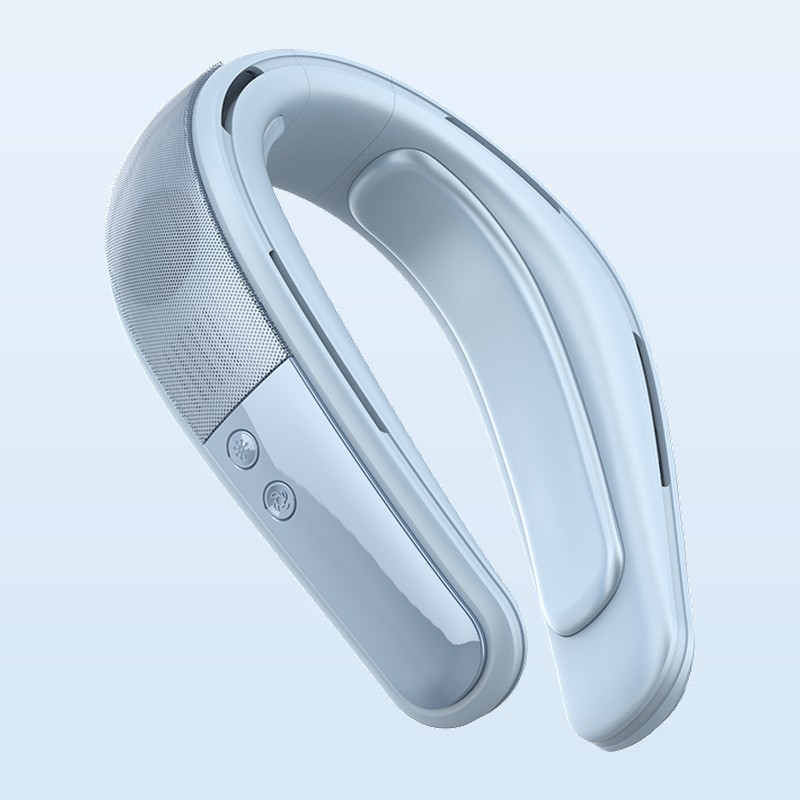
Forty-two square centimetres
The number that decides whether a neck air conditioner feels cold, or just feels like a fan strapped to your shoulders.

Ask ten people what matters most in a neck air conditioner and nine will say battery life. Battery life is measurable and easy to compare, so it wins the spec sheet. But the thing you actually notice in the first thirty seconds — and the thing that decides whether you keep wearing it — is how much cooling plate is touching your neck.
01 — Airflow is not cooling
A fan moves air across skin. If the air is cooler than you, you lose heat by convection and it feels good. On a still, humid afternoon the air is roughly skin temperature, and moving it around accomplishes very little beyond drying your neck. This is why a strong neck fan can feel impressive in an air-conditioned showroom and useless on a scooter at noon.
Contact cooling works differently. A semiconductor plate is driven below skin temperature and heat flows into it by conduction — no air required, no humidity penalty. The catch is that a plate only cools the area it touches, which turns the entire design into a question of geometry.
02 — Why 42 cm² and not 12
Our first plate was small, about the size of two postage stamps, one on each side. It got cold fast, which felt like success in the lab. On a real neck it stopped registering after a minute or two: skin adapts to a local cold spot quickly, and a small plate saturates — it cannot move enough heat to stay below skin temperature once your body starts pushing warmth back into it.
The plate in FB18 is 42 cm², running as one continuous strip along the inside of both arms of the collar. Same power, more area, lower heat flux per square centimetre, so it holds its temperature instead of spiking cold and fading. The sensation is less dramatic at second one and much better at minute ten, which is the only timescale that matters.
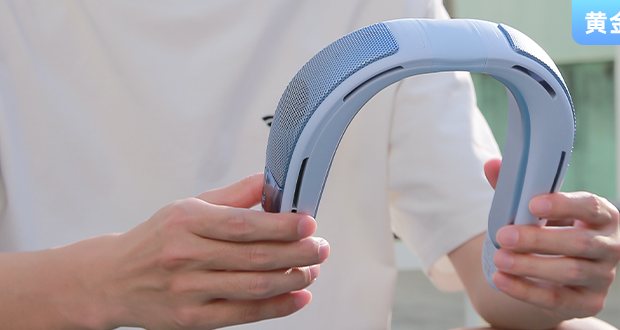
The collar is a triangle rather than a horseshoe. Two contact zones at the sides of the neck, one at the back, and a gap at the front so the device never presses on the windpipe when you look down.
It also means the plate does not fight with a collar or a scarf — the contact happens where clothing already leaves a gap.
03 — 397 grams, and the shoulders
Weight is the second half of the geometry problem. 397 g is not light; a phone is half that. What makes it wearable is where the mass sits: the cell and the motor are in the rear arms, the frame is a yoke that rests on the trapezius, and the front section is deliberately hollow. Nothing hangs from the cervical spine — the load goes across the shoulders, which is how you carry a bag, not how you carry a weight on a strap.
The first prototype was 460 g and sat like a horseshoe on the collarbone. It was fine for five minutes and awful for an hour. Removing 60 g mattered less than moving 100 g of it backwards.
Cold that fades after a minute is not cold. It is a sensation.
04 — Three levels, and a number instead of a guess
Fan speed and plate strength are controlled separately, three steps each. That is not a marketing feature, it is a recognition that the useful combination changes with the environment: outdoors you want airflow high and the plate low, indoors the reverse. A single combined dial forces you to pick the wrong one of the two.
The front panel shows battery as a percentage rather than four bars. Bars are cheaper and prettier; a number is the difference between “I have enough for the ride home” and a guess. Runtime runs from about 1.3 hours at full cooling to 10.5 hours at the bottom of both ranges, from a 4000 mAh pack that charges over Type-C in around three hours.