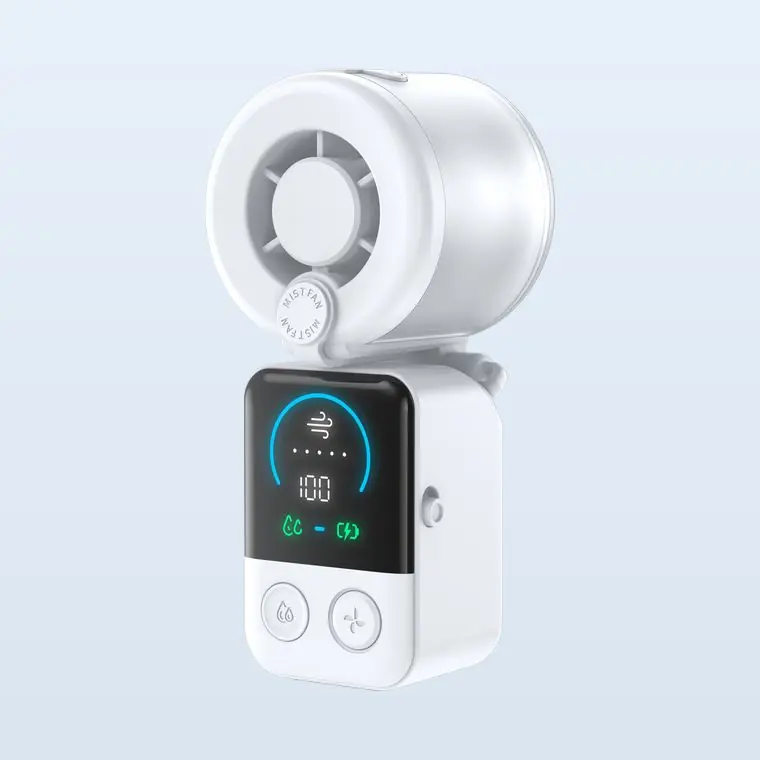
A pocket fan with a second life
Pocket fans are everywhere this year. We built one anyway — then left an empty bay inside it, so a 2000 mAh fan could become a 3000 mAh one without buying a second product.

Pocket fans are the obvious trend of this year. Walk through any summer crowd and you will see the same small rectangle in a dozen hands. Entering a crowded category is usually a bad reason to start a project. We did it anyway, because the pocket format is not a fashion — it is a real constraint that forces you to decide what a fan is for.
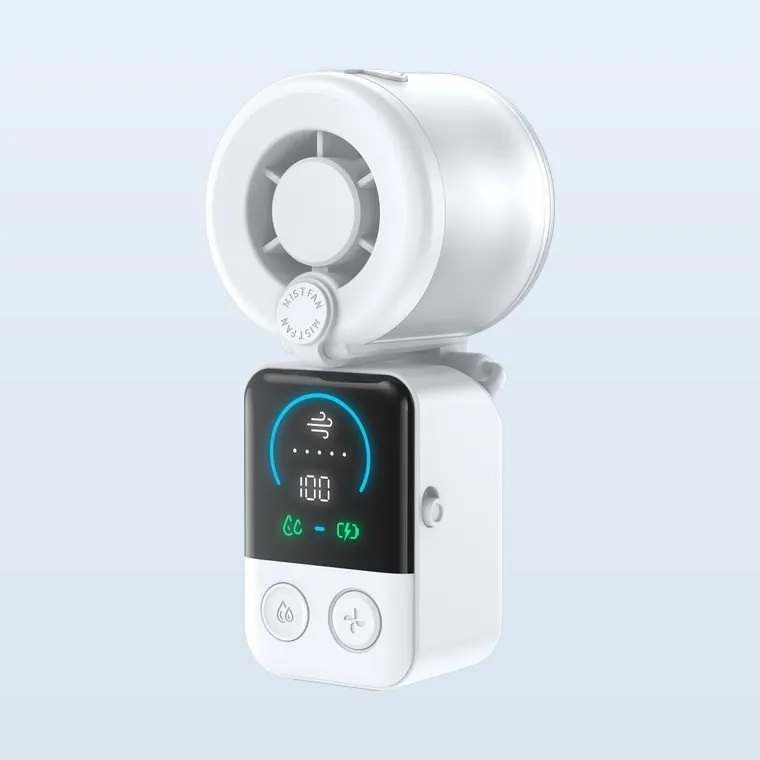
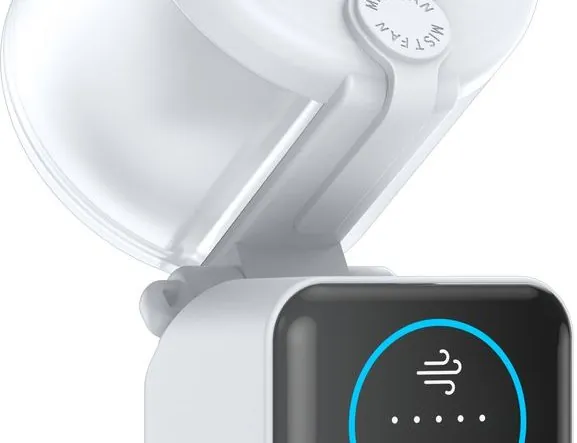
The FS50 is white, minimal and deliberately quiet in the hand. At 55 by 51 by 121 millimetres it is a pocket object first and a fan second. There is a colour screen on the face and a 30 millilitre fill bottle in the box, because we added mist to a format that had previously been dry air only.
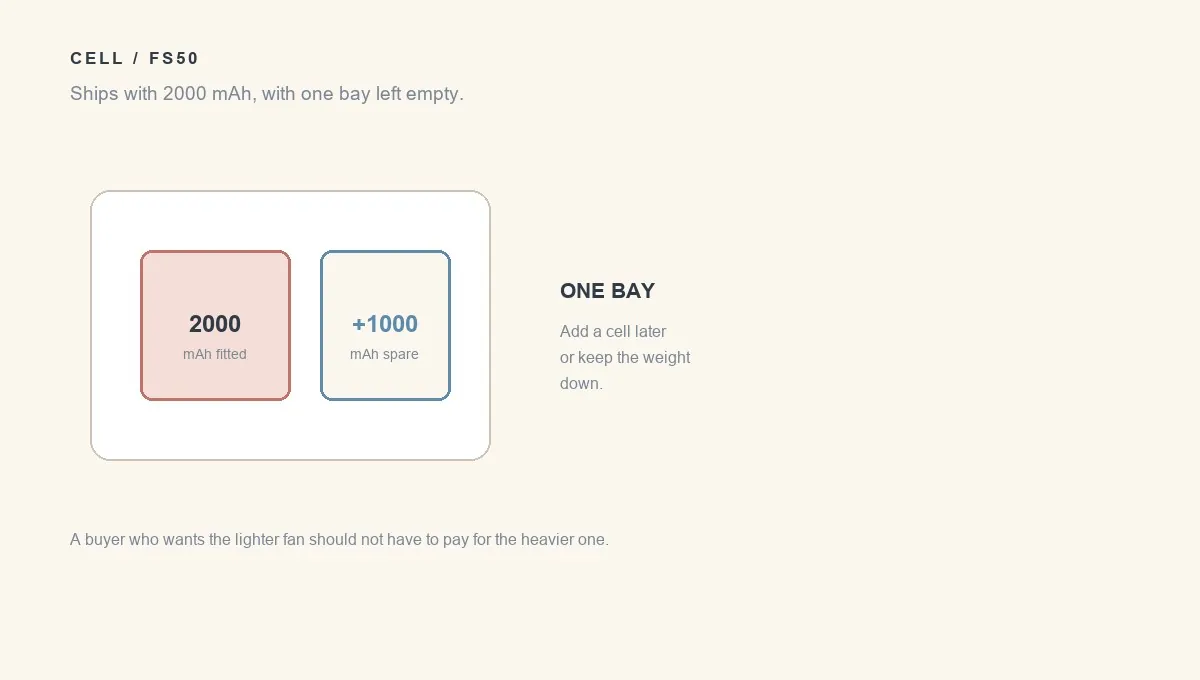
The empty bay is the part nobody sees. The fan ships with a 2000 milliamp-hour cell installed and a second space beside it, waiting. Add a 1000 milliamp-hour cell and the same fan reaches 3000. That decision shaped more of the design than the mist did.
01 — Following a trend on purpose
There is a lazy way to respond to a trend, which is to make the same thing everyone else is making and compete on price. There is also an honest way, which is to ask what the format is good at and build only that. The pocket fan is good at being carried. It lives in a bag or a hand and it is there when the heat arrives, which is more than can be said for a fan you left on a desk.
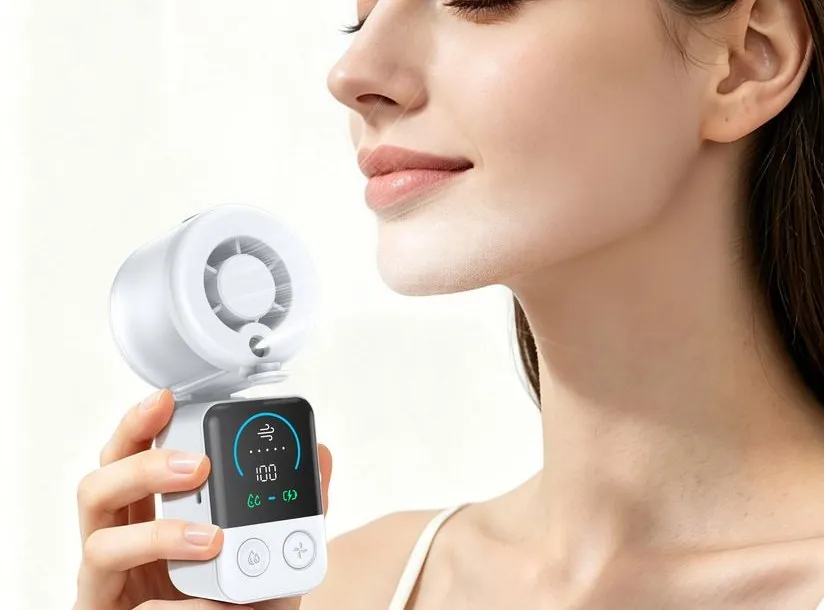
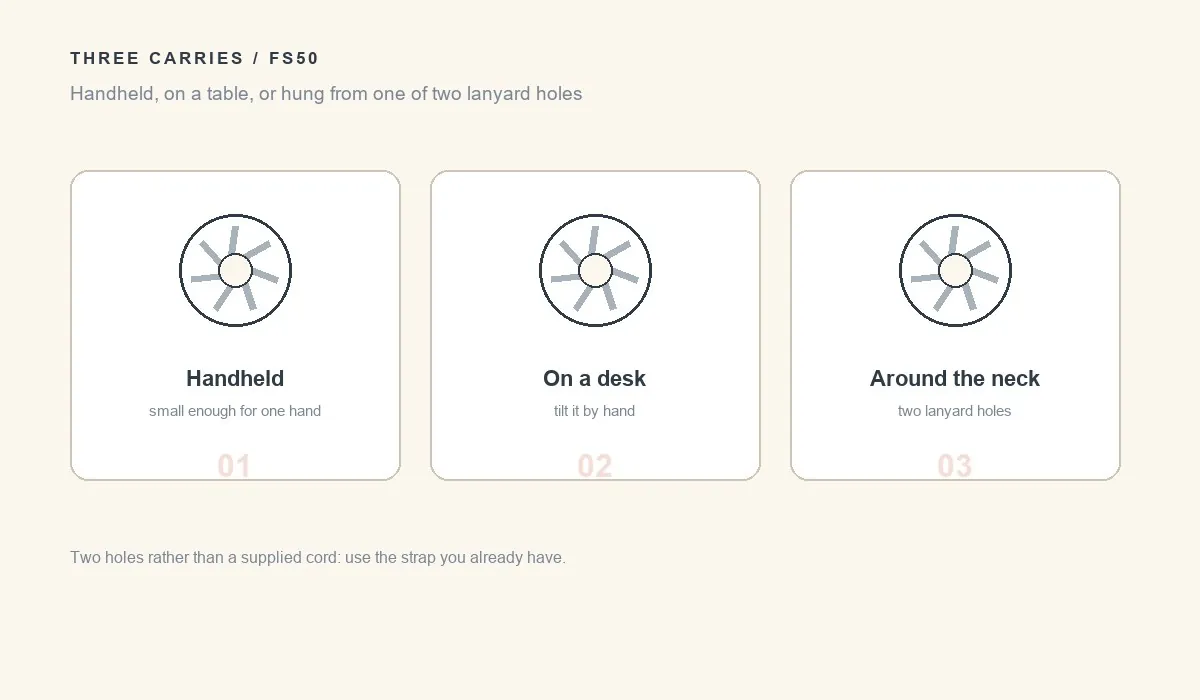
We added mist because a pocket fan has so little room for a large head that it has to do something else to earn its place. A fine spray on the face does that. The FS50 is held the way the picture shows — out of a pocket, up to the face, used for a minute, then forgotten again. That short cycle is what the whole product is built around, not the long continuous run of a desk fan.
02 — Fifty-five by fifty-one by one-twenty-one
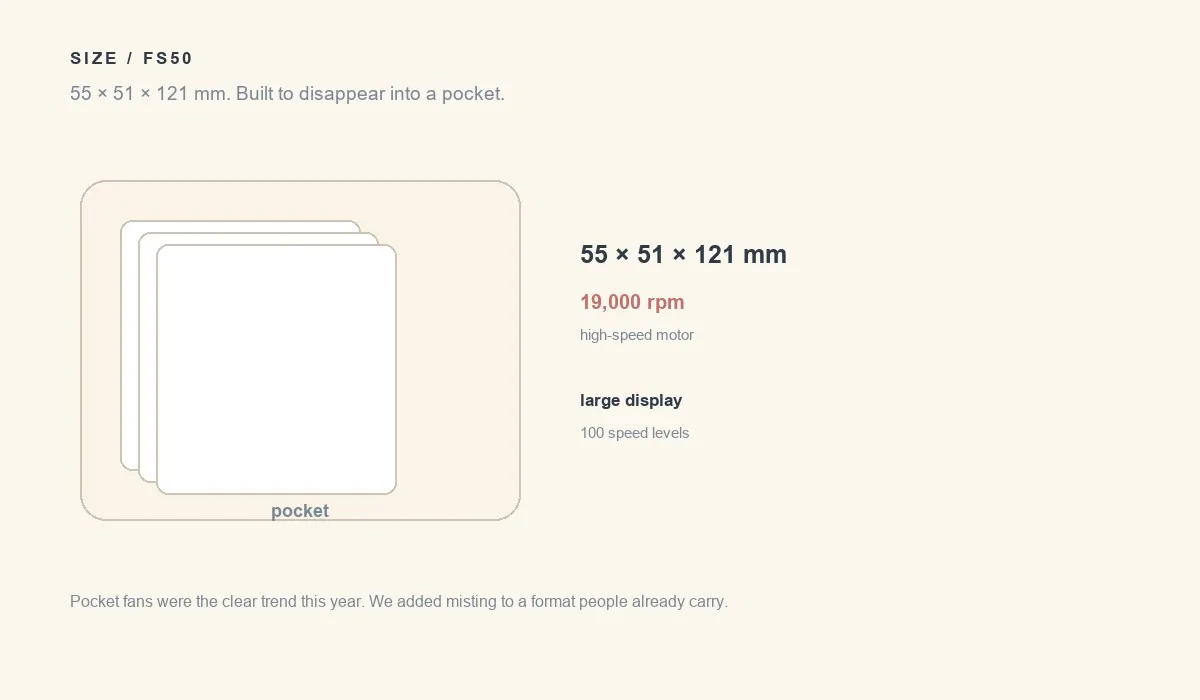
Dimensions decide whether something is carried or left behind. At 55 by 51 by 121 millimetres the FS50 clears the pocket of a jacket and most trouser pockets, and it disappears into a bag without a case. We measured the pocket that mattered — a standard jeans front pocket — and worked back from there. Anything longer and it would stay at home.
That size also sets how you carry it, and we drew all three ways on the same sheet. In the hand, it is a mist fan. On a table, you tilt the head by hand to aim it. Around a neck, two lanyard holes take a cord. None of these required a new mechanism; they are the same small body held differently. When a product is this compact, the carrying method is the feature, not the motor.
03 — Three modes, one object
Handheld, desktop and neck-hanging sound like three products. Here they are three positions of one. The desktop mode uses manual angle adjustment rather than a motor, because a fan this small is usually aimed once and then left. Adding a motor would have added a gear, a failure point and a few millimetres we did not have.
The two lanyard holes are placed so the fan hangs level when worn. That detail took longer than expected — move them a few millimetres and the head points into your chin or your shoulder. We wore prototypes around the workshop until the angle stopped being a complaint. The lesson, as usual, was that a pocket product is judged by how it feels on a body, not by how it looks on a table.
04 — Nineteen thousand turns
The motor spins at roughly 19,000 rpm. In a head this small there is no other way to move a useful amount of air; a larger blade would break the pocket promise. High speed brings noise and vibration, so most of the mechanical work went into keeping those two in check rather than into the number itself. A fast motor that shakes in your hand is worse than a slower one that does not.
The colour screen is the other half of the experience. There are a hundred speed levels, shown as a number you can find again tomorrow, along with the remaining charge. We kept it large because a pocket fan is often used without reading glasses, in a hurry, one-handed. A row of tiny bars would have looked tidier and told you almost nothing.
05 — A bay for a second cell
The fan leaves the factory with a 103450 cell at 3.7 volts and 2000 milliamp-hours, rated at 5 watts and charged through Type-C at 5 volts and 1 amp. Full charge takes about three hours. Beside that cell is an empty bay. Fit a 1000 milliamp-hour cell there and the capacity becomes 3000 — the same body, a longer day, no second fan to carry.
We chose this over simply fitting the larger cell at the factory because most buyers will never need it. At speed 100 with mist on, runtime is about one hour either way; a bigger pack stretches that, but it also adds weight and cost to every unit sold. Offering the bay as a decision keeps the base product honest. The 30 millilitre bottle is small for the same reason: a bigger tank would turn a pocket fan into a handbag fan.
The most useful part of a pocket fan might be the empty space you choose not to fill.